
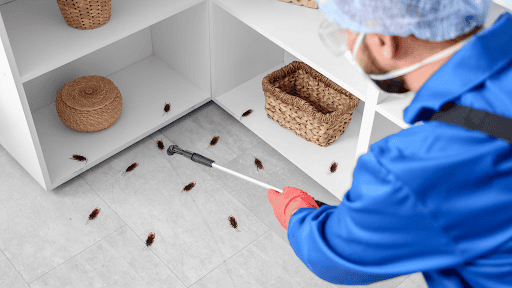
You keep a clean kitchen. Dishes get done, counters wiped, food in containers. Then you flip on the light one night and a small tan cockroach runs behind the toaster. A week later you are seeing them in daylight.
The clean house part is not a coincidence you need to explain away. German cockroaches are not attracted to dirt. They want warmth, water and a gap to hide in, and a spotless kitchen supplies all three.
What they need, and how they breed, explains how they got in and why the spray under your sink will not end this.
What they are actually looking for
German cockroaches want warm, humid areas close to food, water and dark harborage, per the UC Statewide IPM Program, preferring roughly 70°F to 75°F. That is the inside of every house in the valley.
They also need almost no space. An adult can hide in a crack 1/16 inch wide. The gap where your countertop meets the backsplash qualifies, as does the seam behind a dishwasher, the void under a fridge, and a cabinet hinge recess.
Food is what people fixate on, and it is the least limiting factor. Grease behind the range, crumbs in a drawer track, pet food residue, or the glue on a cardboard box is enough. You cannot clean a kitchen to a standard that starves them. Taking away the water and the harborage matters far more.
In the Coachella Valley that point is sharper than almost anywhere else. Outdoors here is lethally dry for this species, so there is no outdoor population waiting to come back in. Whatever you have is living inside, clustered tight around indoor moisture: the under-sink cabinet with a slow drip, the dishwasher pan, the water heater closet, the fridge drip tray.
They did not come from your housekeeping
German cockroaches are carried in. The usual routes:
- Grocery bags and cardboard boxes, especially produce and beverage cases
- Secondhand appliances, particularly microwaves and coffee makers, which hold warmth and dark voids
- Used furniture, electronics, moving boxes and returned luggage
- Shared walls and shared plumbing in condos, apartments and attached units
That last one matters here. Where units share walls, roaches move through utility penetrations and wall voids between them. A neighbor’s untreated unit keeps reseeding yours no matter how well you handle your own, which is why HOA and multi-unit pest control has to run building-wide rather than door by door.
The egg case is the whole reason they come back
This is the part that explains everything else.
A female produces an egg capsule, called an ootheca, holding about 30 young. She does not glue it into a crack and leave. She carries it protruding from her abdomen for most of the roughly 30-day incubation and drops it about the time the eggs hatch. Sometimes it hatches while she is still carrying it.
That is why sprays fail. The next generation is physically attached to an adult that stays hidden deep in a void. She is not the one running across your counter, and she is not the one contacting your residual spray.
Then she does it again. A female produces a new egg case every few weeks, and UC IPM notes that a single female and her offspring can produce over 30,000 individuals in a year. German cockroaches have the fastest reproductive cycle of any common pest cockroach.
So the pattern goes: you spray, you kill the foragers you can see, things look better for ten days, the capsules hatch, and you are worse off than before, because the survivors are the ones that avoided your product.
Why spraying makes it worse
Three separate problems stack up here.
Sprays do not last. UC IPM states that insecticide sprays do not provide long-term control. Penn State Extension is harsher, calling residual sprays and aerosol foggers indoors “of little value in controlling German cockroaches.”
Sprays scatter them. Many products are repellent. Rather than killing roaches, they push them elsewhere. Penn State notes spraying “may disperse the cockroaches, making control difficult and lengthy.” A problem behind the dishwasher becomes a problem in the bathroom, the bedroom closet and the neighbor’s unit.
They are already resistant. Cockroaches have become resistant to many insecticides in the common sprays and aerosols that used to control them.
Foggers combine all three failures. The pesticide has to contact the insect, and roaches sit in voids the fog never reaches.
Why bait works
Bait products are the primary pesticides used against cockroach infestations, per UC IPM. The reason is behavioral rather than chemical.
Bait is slow-acting and non-repellent, so roaches feed and return to harborage before it takes effect. You are delivering the active ingredient into the void where the egg-carrying females live, the one place a surface spray cannot reach. Nymphs that never leave harborage feed on it too.
Two rules make or break this:
- Do not spray near bait. Repellent residue contaminates it and roaches stop feeding. Spraying and then baiting wastes the bait, and it is the most common self-inflicted failure.
- Do not clean the bait away. Placements go inside cracks, hinge voids and cabinet corners, not on open surfaces.
Bait alone is not the whole answer. UC IPM is explicit that pesticides alone will not solve a cockroach problem, and an integrated approach is usually required.
Are you sure they are German cockroaches?
Worth checking, because the answer changes the plan completely.
If you are seeing large roaches, an inch and a half or longer, at night, near a drain, garage, slab crack or irrigation box, those are probably an outdoor species. UC IPM lists Turkestan cockroaches living in water meter boxes, cracks between blocks of poured concrete, compost piles, leaf litter and potted plants, plus American and oriental cockroaches in sewers and storm drains. In an irrigated desert yard, meter boxes and drip-irrigated planters are exactly that habitat.
Those are an exterior problem. German cockroaches are small, tan, about half an inch, seen indoors and increasingly in daylight as numbers climb. Getting the species right matters, because most advice on how to get rid of roaches is written for one and applied to the other.
What actually clears an infestation
- Find and fix the water. A dripping trap or leaking dishwasher gasket anchors most kitchen infestations.
- Reduce harborage. Caulk the backsplash gap and pipe penetrations, and lose the cardboard storage, which is both shelter and food.
- Vacuum cracks and crevices to pull out roaches, egg cases and debris. UC IPM recommends HEPA or triple-filter equipment.
- Bait in voids, and stop spraying.
- Monitor with sticky traps so you know whether numbers are dropping.
- Treat adjoining units at the same time if you share walls.
There is a health reason to take this seriously beyond the discomfort. UC IPM notes that indoor cockroach infestations “are also important sources of allergens and have been identified as risk factors for development of asthma in children, especially within multi-unit housing environments.”
Frequently asked questions
Does having roaches mean my house is dirty?
No. German cockroaches need warmth, moisture and a crack to hide in, and they arrive in groceries, boxes, used appliances or through shared walls. Sanitation affects how fast a population grows, not whether you get one.
Why do I see more roaches after I spray?
Repellent sprays push roaches out of harborage into new areas rather than killing them. That is dispersal, not a dying population, and the carried egg capsules are unaffected.
How long does it take to clear a German cockroach infestation?
Expect weeks, not days, because you have to outlast the capsules already carried by hidden females. A capsule takes about 30 days to incubate, so any real program runs through at least one full cycle with follow-up visits.
Can I use bait and spray together?
Not in the same areas. Repellent spray residue contaminates bait and stops roaches from feeding on it. Choosing bait means committing to it.
The short version
German cockroaches show up in clean homes because clean homes are warm, have plumbing, and have a thousand cracks 1/16 inch wide. They stay because females carry their egg capsules deep in voids where surface sprays never reach, and they rebound because every capsule holds about 30 more.
Working out how to get rid of roaches comes down to three moves: kill the moisture, close the harborage, and put non-repellent bait where the breeding females actually live. Then stop spraying, because spraying is what has been scattering them.
If you have been at this for over a month, or you share walls with units nobody is treating, it is worth having someone inspect the voids. Rudy’s Termite & Pest Control handles roach control throughout the Coachella Valley and offers ongoing maintenance programs where reintroduction is the real risk, from Indio out through the valley. Call (760) 775-7216 to have someone find where the water and the harborage actually are.