Seeing one roach is never just one roach.
Cockroaches are nocturnal and secretive. For every one you spot scurrying across the kitchen floor at midnight, there are usually dozens more you never see. And if you are spotting them during the day, the hidden population is large enough that they are being pushed out of their harborage.
The good news is that roaches are beatable, and faster than most people think, if you use methods that actually work. The bad news is that the products most homeowners reach for first are the ones that work worst.
Let us fix that.
Know Your Enemy First
In Coachella Valley homes, you are usually dealing with one of two roaches, and the difference matters.
German roaches are small, light brown, and live indoors. They breed at a staggering rate. A single female produces an egg case containing 30 to 40 eggs, and those offspring are breeding within weeks. German roach infestations explode. This is the roach behind your refrigerator and under your sink.
American roaches are the big ones, sometimes called sewer roaches or water bugs. They live primarily outdoors and in drains, wandering inside for water and shelter, especially during summer heat.
German roaches require an aggressive indoor baiting strategy. American roaches are mostly an exclusion and outdoor problem. Everything below covers both.
Why Sprays Make Things Worse
Here is the counterintuitive truth about roach control: the spray can is your worst weapon.
Repellent sprays kill the roaches you hit and scatter the rest. German roaches respond to spray by dispersing deeper into walls and spreading to new rooms, sometimes splitting one kitchen infestation into a whole-house problem.
Foggers are even worse. The mist never penetrates the cracks and voids where roaches actually live, and it contaminates every surface in the room while doing it.
If you take one thing from this article, take this: put down the spray, pick up the bait.
Step 1: Deep Clean With a Purpose
Roaches need three things: food, water, and harborage. Your first job is to make all three scarce.
Degrease the stove, the hood, and the cabinets around them. Grease is roach fuel. Clean under and behind the refrigerator, where crumbs and moisture accumulate for years untouched.
Do not leave dishes overnight. Store food, including pet food, in sealed containers. Empty the trash nightly during an active infestation.
Fix every drip and leak. Roaches can survive weeks without food, but only days without water. Dry homes are hostile territory.
Step 2: Bait, Don’t Spray
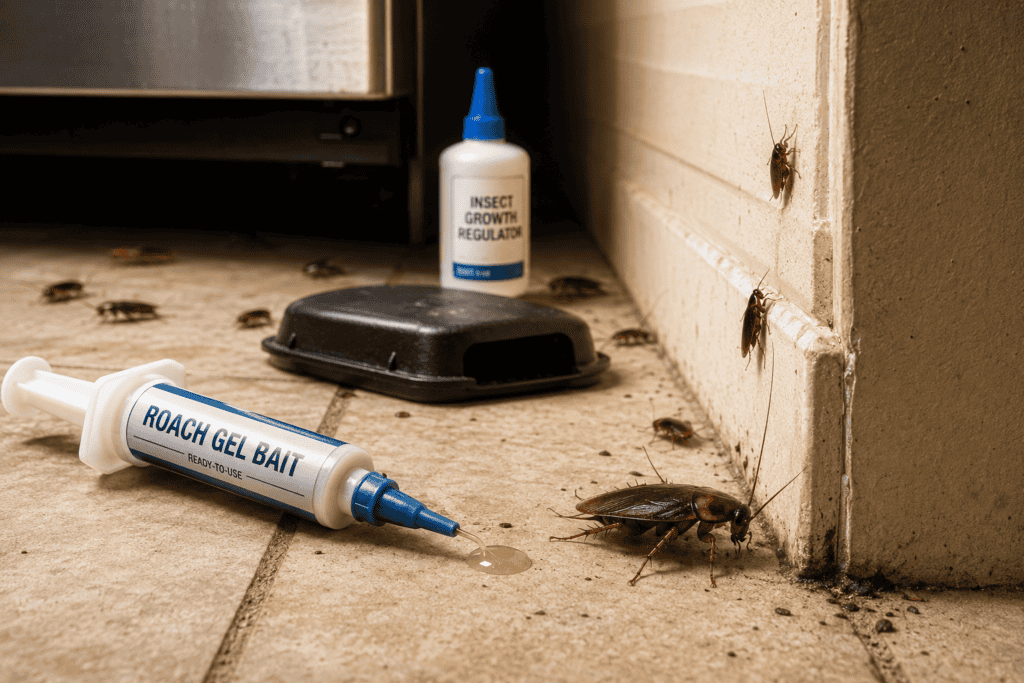
Gel baits are the single most effective consumer weapon against roaches, and it is not close.
Roaches eat the bait, return to their harborage, and die there. Other roaches eat their droppings and carcasses, spreading the poison deeper into the population than any spray could reach. This is called the domino effect, and it is why baits collapse infestations while sprays just relocate them.
Placement is everything:
- Apply small dots of gel bait in cracks and crevices near activity, not big smears in the open
- Focus on under the sink, behind appliances, cabinet hinges, and wall voids
- Never spray insecticide near your bait placements, because it contaminates the bait and roaches avoid it
- Refresh bait every couple of weeks, since dried bait loses attractiveness
Pair baits with insect growth regulators if available. These prevent nymphs from maturing into breeding adults, breaking the reproductive cycle while the bait kills the current generation.
Boric acid, dusted thinly in voids and behind appliances, is a useful supporting player. Thin is the key word. Roaches walk around piles.
Step 3: Seal Their Highways
While the bait works, close off the routes roaches use to move in and around your home.
Caulk cracks along baseboards, around pipe penetrations, and where countertops meet walls. Add covers to drains, since American roaches travel through plumbing. Weatherstrip exterior doors.
Roaches enter homes through gaps most homeowners have never inspected. Our guide to common entry points pests use to get inside your home walks through the checklist room by room.
Outdoors, clear mulch and leaf litter away from the foundation, and address moisture around irrigation lines. In the desert, your irrigated landscaping is an oasis that attracts roaches to the perimeter of your home. From there, it is a short walk inside, which is one reason pests stay active year-round in the Coachella Valley.
Step 4: Monitor Your Progress
Sticky traps are your scoreboard.
Place them under the sink, behind the toilet, next to the refrigerator, and along baseboards. Check them weekly.
Declining catches mean your baiting is working. Consistent or growing catches after two to three weeks mean the infestation is bigger than consumer products can handle.
Why Roaches Are a Health Issue, Not Just a Gross One
This part deserves more attention than it gets.
Roaches spread bacteria like Salmonella and E. coli as they travel from drains and trash to your counters and dishes. But the bigger issue is respiratory.
Roach droppings, shed skins, and saliva are potent allergens. The Asthma and Allergy Foundation of America reports that cockroach allergens are a major trigger for asthma attacks, particularly in children, and studies in urban housing have linked roach allergen exposure directly to increased asthma severity in kids.
A roach infestation is not something to live with while you slowly experiment. The EPA’s guidance on cockroach control emphasizes the same integrated approach outlined here: sanitation, exclusion, and targeted baiting over broadcast spraying.
When to Call a Professional
Be honest about the situation in front of you.
If you are seeing roaches during daylight, finding them in rooms far from the kitchen, spotting egg cases, or noticing a musty odor, you are past the point where gel bait alone will win. German roaches in particular outbreed casual control efforts.
A professional roach exterminator uses commercial-grade baits, growth regulators, and crack-and-crevice treatments that reach the harborage areas consumer products cannot. More importantly, a professional can tell you which species you have and where the population actually lives, which is half the battle.
If you have been going back and forth on doing it yourself, our honest comparison of DIY pest control vs professional pest control lays out where each one makes sense.
FAQs
What kills roaches the fastest?
For the individual roach, contact sprays. For the infestation, gel baits. The distinction matters because killing visible roaches does nothing to the breeding population hidden in walls and voids. Baits typically show major results within one to three weeks.
Why do I have roaches in a clean house?
Roaches need water and shelter as much as food. Plumbing leaks, drain access, and warm appliance motors attract roaches even in spotless kitchens. Cleanliness helps, but it is not a force field.
Does killing a roach attract more?
Not directly, but the conditions that attracted the first roach are still attracting others. Crushed roaches can release pheromones, so clean up remains rather than leaving them.
Do roaches go away on their own?
No. If roaches found what they need in your home, they stay and multiply. German roaches especially never leave voluntarily. The population only moves in one direction without intervention.
Are sewer roaches the same as German roaches?
No. Sewer roaches, usually American roaches, are large outdoor roaches that wander in. German roaches are small indoor breeders. The big one in your bathroom at night is usually a wanderer. The small ones in your kitchen are residents, and they are the bigger problem.
How long does it take to get rid of roaches completely?
Light infestations respond to consistent baiting in two to four weeks. Heavy German roach infestations can take several weeks even with professional treatment, because egg cases keep hatching. Follow-up treatment is what makes results permanent.
End the Infestation for Good
Roaches are one of the most stubborn pests a homeowner can face, but the playbook above beats them when applied consistently. If the problem has already outgrown DIY, or you would rather not spend weeks finding out, contact Rudy’s Termite & Pest Control and we will identify what you are dealing with and hit it at the source.