
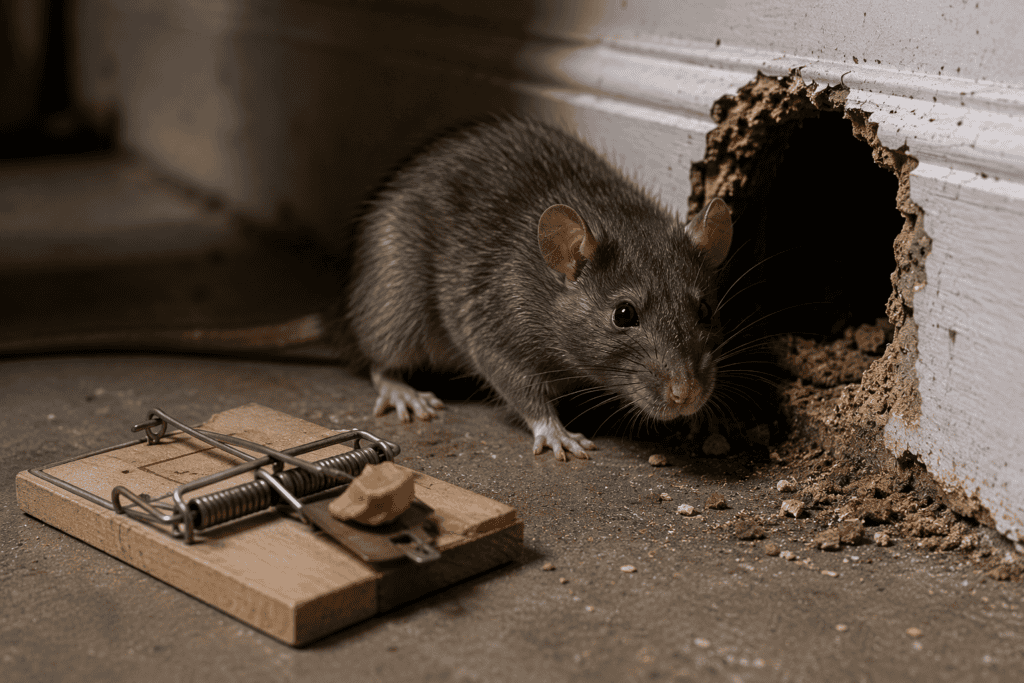
Finding a rat in your home changes how the whole house feels.
Every noise in the walls becomes suspicious. Every shadow in the garage gets a second look.
The instinct is to reach for the strongest poison on the shelf and end it fast. But if you have children or pets, that instinct can create a bigger problem than the rats themselves.
Here is the reality: the most effective rat control methods are also the safest ones. Poison is not the shortcut it appears to be. This guide walks you through how to get rid of rats the right way, without putting your family at risk.
Why Poison Should Be Your Last Resort
Rodenticides seem simple. Put out bait, rats eat it, problem solved.
The problems show up later.
Poisoned rats do not die where you can find them. They crawl into wall voids, attics, and crawl spaces, where they die and decompose. The odor can last for weeks, and removing the carcass sometimes means cutting into drywall.
More importantly, rodenticides are a real hazard for the rest of your household. The EPA regulates rodenticides specifically because of the risk they pose to children, pets, and wildlife. Dogs are notorious for finding bait that homeowners were sure was hidden. And a pet that eats a poisoned rat can suffer secondary poisoning without ever touching the bait itself.
Safe rat control starts with a different mindset. You are not trying to poison your way out. You are trying to make your home impossible for rats to live in.
Step 1: Figure Out Where They Are and How They Got In
Rats leave evidence everywhere they go.
Droppings the size of olive pits. Grease marks along baseboards where their fur rubs the wall. Gnaw marks on wood, wiring, and food packaging. Scratching sounds in the ceiling at night.
If you are not sure what you are dealing with yet, start with these four rat infestation warning signs and follow the trail.
Then find the entry points. Rats can squeeze through openings the size of a quarter. Check around pipes, vents, rooflines, garage doors, and foundation cracks. Most homes have more entry points pests use to get inside than their owners ever realize.
Step 2: Cut Off Food and Water
Rats stay where the living is good.
Store pantry food in sealed containers, not original packaging. Rats chew through cardboard and thin plastic without effort.
Feed pets indoors and pick up bowls after meals. Pet food left in the garage or backyard is one of the most common rat attractants we see. So is fallen fruit from citrus trees, which is a year-round buffet in Coachella Valley yards.
Secure trash in bins with tight-fitting lids. Fix leaky pipes and irrigation heads. In a desert climate, a reliable water source is just as attractive to rats as food. We covered this in detail in our guide on what attracts rats to homes in Indio.
Step 3: Seal Every Entry Point
This is the single most important step, and the one most people skip.
Trapping without sealing is a treadmill. You remove rats, new rats move in, and the cycle repeats forever.
Seal gaps with materials rats cannot chew through. Steel wool stuffed into openings and secured with caulk works for small gaps. Hardware cloth, sheet metal, and concrete work for larger ones. Skip the expanding foam on its own, because rats chew through it in a night.
Pay special attention to the roofline. Roof rats, the most common rat in Southern California, are excellent climbers and often enter through attic vents and gaps where the roof meets the walls.
Step 4: Trap the Rats Already Inside
With entry points sealed and food removed, trapping becomes dramatically more effective. The rats have fewer options, and your traps become the best game in town.
Classic snap traps remain one of the most effective and humane options when used correctly. Death is instant, there is no poison in your home, and you can verify and remove every rat you catch.
Placement matters more than the trap itself:
- Set traps along walls, where rats naturally travel, with the trigger end facing the baseboard
- Use peanut butter, nuts, or dried fruit as bait
- Set traps unbaited-but-unset for a few days first so rats learn to trust them
- Place traps inside cabinets, behind appliances, or in closed rooms where kids and pets cannot reach them
If pets or curious toddlers make open traps too risky, enclosed bait stations that hold snap traps solve the access problem while keeping the trap effective.
Avoid glue traps. They are inhumane, they catch non-target animals, and a panicked, still-living rat stuck to a board is not a situation any homeowner wants to handle.
Step 5: Clean Up Safely
Rat droppings and urine are not just unpleasant. They can carry bacteria and viruses that spread to humans, which is why the CDC recommends specific precautions when cleaning up after rodents.
Never sweep or vacuum droppings dry. That sends particles into the air.
Instead, ventilate the area, spray droppings with a disinfectant or bleach solution, let it sit for five minutes, then wipe up with paper towels while wearing gloves. Wash your hands thoroughly afterward.
When the Problem Is Bigger Than a Few Traps
Sometimes the honest answer is that a DIY approach is not enough.
If you are hearing activity in multiple areas of the house, finding fresh droppings daily, or catching rats week after week without progress, you are likely dealing with an established population. Rats reproduce fast. A pair of rats can turn into dozens in a few months.
A professional rat exterminator will locate nesting sites you cannot see, seal entry points you missed, and remove the population using methods that are safe for your household. For ongoing problems, a full rodent control program addresses the conditions that keep bringing rats back.
If you want to go deeper on identifying the problem first, our guide to rodent problems in the Coachella Valley covers the signs in detail.
FAQs
What is the fastest way to get rid of rats?
Sealing entry points and trapping is the fastest reliable method. Poison seems faster but often creates dead rats in walls, risks to pets, and a population that rebounds because the entry points were never fixed.
How do I get rid of rats without poison?
Remove food and water sources, seal every entry point larger than a quarter, and use snap traps placed along walls. This combination solves most infestations without a drop of rodenticide.
Are rats dangerous to my pets?
Yes, in two ways. Rats can carry diseases and parasites transmissible to pets, and rodenticide use puts pets at risk of primary or secondary poisoning. Safe control methods protect your pets on both fronts.
Why do I keep getting rats even after trapping?
Because the attractants and entry points are still there. Rats have excellent memories and strong survival instincts. Until the food, water, and access are gone, new rats will keep replacing the ones you remove.
Do ultrasonic repellents work on rats?
Independent testing has consistently shown poor results. Rats may avoid the area briefly, then habituate within days. Money spent on ultrasonic devices is better spent on sealing materials and quality traps.
How many rats do I have if I saw one?
Rats are nocturnal and avoid humans. Seeing one during the day often means the nest is crowded enough to push rats out at odd hours. Assume there are more than one and act accordingly.
Protect Your Home the Safe Way
You do not have to choose between a rat-free home and a safe one. If you are seeing the signs and want the problem handled without risk to your family or pets, get in touch with Rudy’s Termite & Pest Control for an inspection. We will find how they are getting in and close the door for good.