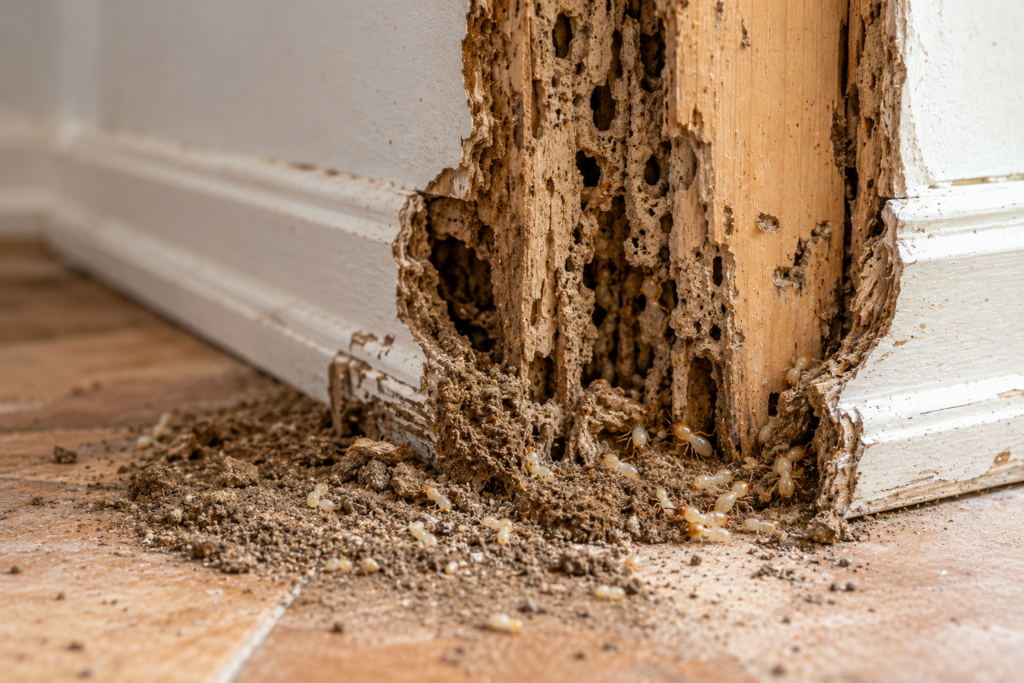
Termites are the most expensive pest you will ever ignore.
They do not bite you. They do not scurry across the kitchen floor. They give you almost no reason to think about them, which is exactly how they cause billions of dollars in property damage across the United States every year, damage that homeowners insurance almost never covers.
By the time most homeowners discover termites, the colony has been feeding for months or years.
So this guide covers two things: how to get rid of termites that are already in your home, and how to catch them early enough that treatment stays simple and repairs stay small.
First, Confirm It Is Actually Termites
Before anything else, make sure you are dealing with termites and not ants.
Every spring, winged ants swarm at the same time as termites, and homeowners regularly panic over the wrong insect. Termite swarmers have straight antennae, equal-length wings, and a thick waist. Flying ants have bent antennae, unequal wings, and pinched waists. Our guide on ant swarmers vs termites breaks down the differences with everything to look for.
Then look for the classic evidence:
- Mud tubes running up the foundation
- Piles of droppings, called frass, that look like coffee grounds
- Discarded wings on window sills
- Wood that sounds hollow when tapped
- Doors and windows that suddenly stick
If any of these look familiar, our full guide to the signs of termite activity will help you assess what you are seeing.
Know Which Termite You Have
This matters more than almost anything else, because the two termites in our region require completely different treatments.
Subterranean termites live in the soil and travel into your home through mud tubes. They need moisture and soil contact. Treatment targets the ground around and under your home.
Drywood termites live entirely inside the wood they are eating. No soil, no mud tubes. They are especially common in the Coachella Valley, and colonies can exist in attic framing, door frames, and furniture. Treatment targets the wood itself.
Many homes in our area deal with both, sometimes at the same time. We covered why the desert is such a hotspot in our guide to termites in the Coachella Valley.
Treatment Options for Subterranean Termites
Liquid soil treatments. A licensed applicator creates a treated zone in the soil around the foundation. Modern non-repellent termiticides are transferred between termites through contact, spreading the effect through the colony. Applied correctly, a soil treatment protects a home for years.
Bait systems. Stations placed in the soil around the home contain a slow-acting bait that foraging termites carry back to the colony. Bait systems eliminate the colony itself and work well as long-term monitoring and prevention.
Both approaches require professional equipment and licensing. Trenching, drilling, and correct application rates are not realistic DIY territory, and a partial barrier is barely better than none. Termites find the gap.
Treatment Options for Drywood Termites
Localized treatment. When an infestation is confined to a known, accessible area, targeted injections into the infested wood can eliminate the colony. This works when the inspection confirms the infestation is limited.
Whole-structure fumigation. When drywood termites are established in multiple areas, or in areas that cannot be reached, tent fumigation is the only method that reaches every colony in the structure at once. The home is sealed and treated with a gas that penetrates all wood. It is the most thorough option available for widespread drywood infestations.
Heat treatment. An alternative for some situations, raising wood temperatures to lethal levels without chemicals.
The EPA’s guide to termite control makes an important point: termite treatment is one of the few pest categories where the agency explicitly recommends professional application, because the products, volumes, and techniques involved are beyond consumer use.
What About DIY Termite Products?
Here is the direct answer: orange oil, vinegar, spot sprays from the hardware store, and DIY foams have a place in exactly one scenario, which is a tiny, fully visible, fully accessible drywood colony. And even then, you are betting the structure of your home on your inspection being right.
Research from the University of California’s Integrated Pest Management program is blunt about over-the-counter termite products: they kill the termites they touch and leave the colony intact. Meanwhile, the colony keeps feeding around the clock.
The cost math tells the story. A professional treatment might cost hundreds to a few thousand dollars. Structural repairs from a mature, untreated infestation routinely run tens of thousands, and insurance treats termite damage as neglected maintenance, not a covered loss.
With termites, the expensive decision is waiting.
Prevention: The Cheapest Treatment You Will Ever Buy
Once termites are gone, or before they ever arrive, prevention is straightforward:
- Eliminate wood-to-soil contact anywhere on the structure
- Fix leaks, improve drainage, and keep irrigation from soaking the foundation
- Store firewood and lumber away from the house and off the ground
- Seal cracks in the foundation and gaps around utility lines
- Keep attic and crawl space vents screened and unblocked
We put together 4 tips for preventing termites that expand on each of these.
But the single most valuable prevention step in a high-pressure area like ours is the annual inspection. Termites work silently between the moments you happen to notice them. A trained inspector finds activity years before it becomes visible, when treatment is small and cheap. If you have never had one, or it has been more than a year, a professional termite inspection is the place to start. And if you want to check your own home first, our guide on how to spot termite damage before it spreads covers the walkthrough step by step.
FAQs
Can I get rid of termites myself?
Realistically, no. Subterranean treatments require trenching and specialized termiticides. Drywood infestations hide inside wood where surface products cannot reach. DIY attempts usually just delay professional treatment while damage continues.
How fast do termites damage a home?
A mature subterranean colony can number in the hundreds of thousands and feeds around the clock. Noticeable structural damage typically takes months to years, which sounds slow until you realize colonies often go undetected for exactly that long.
What kills termites instantly?
Direct contact insecticides kill individual termites on the spot, but the colony, including the queen, is never where you are spraying. Colony elimination requires treatments that spread through the population, like non-repellent termiticides and baits.
How do I know if termites are active or the damage is old?
Live termites, fresh frass piles that reappear after cleaning, and intact mud tubes indicate active infestation. A professional inspection can confirm activity and distinguish new damage from old, which matters enormously for treatment decisions.
Does homeowners insurance cover termite damage?
Almost never. Insurers classify termite damage as preventable maintenance. This is the strongest financial argument for annual inspections, since prevention is the only coverage you can actually buy.
How often should I get a termite inspection in the Coachella Valley?
Annually. Both drywood and subterranean termites are active year-round in the desert, and an annual inspection catches new activity while treatment is still simple and inexpensive.
Protect Your Biggest Investment
Termites never get better on their own, but caught early, they are a manageable problem instead of a financial disaster. If you have seen any of the warning signs above, or simply cannot remember your last inspection, schedule a termite inspection with Rudy’s Termite & Pest Control and know exactly where your home stands.